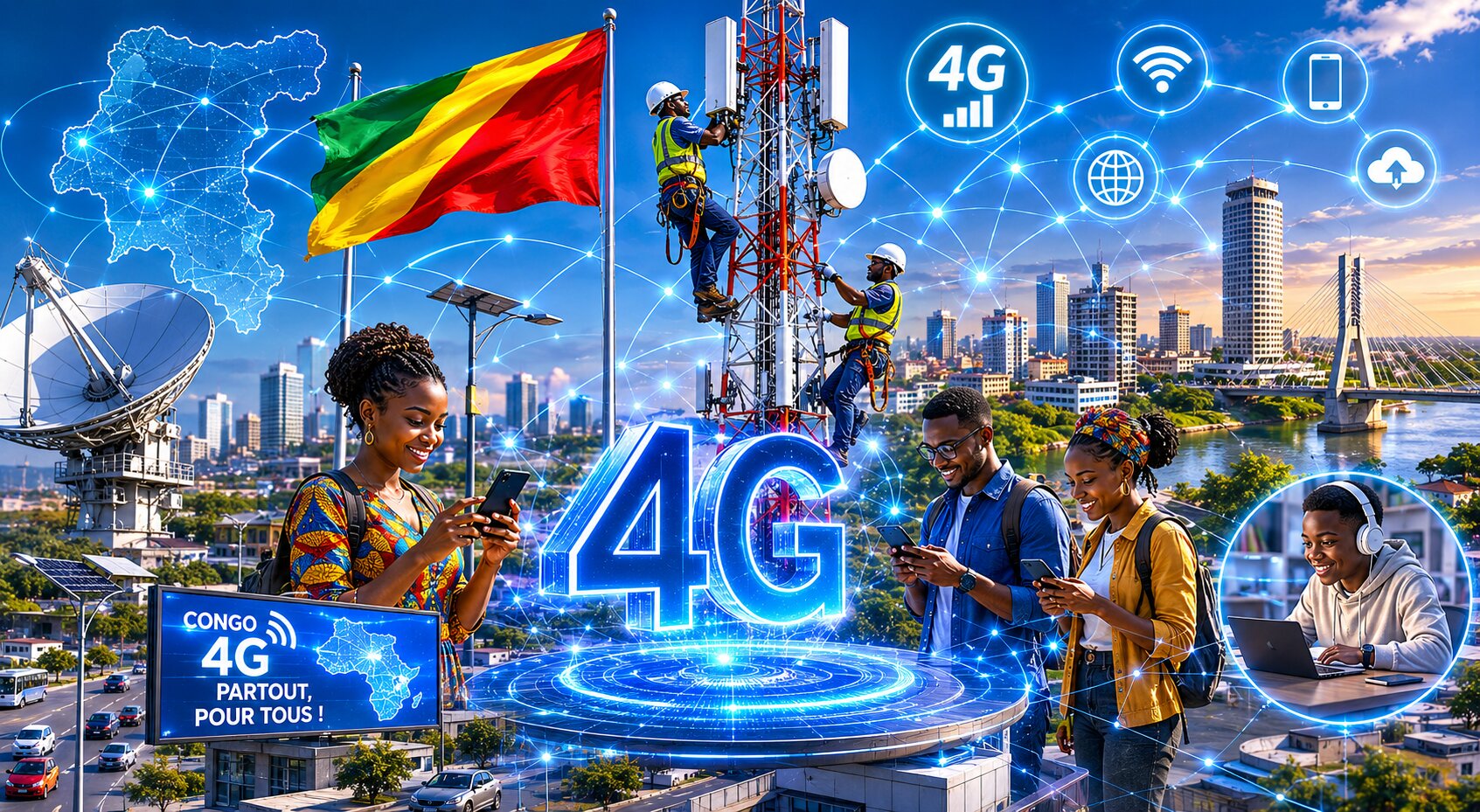
Congo's Digital Leap: A Nationwide 4G Rollout
The Republic of Congo is experiencing a rapid digital transformation, positioning it as a key driver for a modern economy. Under the vision of President Denis Sassou N'Guesso, the Congolese government is intensifying structural reforms to ensure high-speed mobile internet coverage across the entire nation. This technological strategy is vital, extending 4G technology from Brazzaville to the country's most remote regions. The state's efforts are aimed at digitally integrating isolated areas, boosting financial inclusion through Mobile Money services, and laying the groundwork for a sovereign and competitive digital economy.
The Evolution of Mobile Broadband in Congo
The journey of 4G mobile networks in the Republic of Congo began in the mid-2010s, marking a significant technological shift from older 2G and 3G networks. Major operators such as MTN Congo and Airtel Congo secured official authorizations from the Regulatory Agency for Posts and Electronic Communications (ARPCE). Initial commercial launches primarily targeted the country's two main economic and demographic hubs: the political capital, Brazzaville, and the economic capital, Pointe-Noire. These urban centers immediately experienced a substantial improvement in connectivity, facilitating commercial exchanges and access to online services.
Subsequently, operator strategies, strongly influenced by government requirements, focused on extending coverage along the national backbone. Departmental capitals connected by national roads or railways progressively upgraded to broadband. This technical enhancement popularized smartphone usage, transforming Congolese consumption habits as many migrated to video streaming, social media, and professional applications, leading to an exponential increase in mobile data traffic nationwide.
Bridging the Digital Divide in Remote Departments
Despite significant progress in southern and urban areas, access to broadband long highlighted substantial geographical disparities. Northern departments, including Likouala, Sangha, Cuvette, and Cuvette-Ouest, along with rural areas of Lékoumou and Pool, faced major logistical challenges. The isolation of certain localities and a lack of stable energy infrastructure hindered the installation of 4G base stations by operator technical teams.
To rectify this imbalance and ensure equal digital opportunities, the Ministry of Posts, Telecommunications, and Digital Economy has launched numerous territorial development initiatives. Through the Universal Access Fund for Electronic Communications (FASUCE), managed by ARPCE, projects to cover underserved areas have been deployed. Formerly isolated localities now benefit from shared antennas or solar-powered installations, allowing local populations, departmental administrations, and agricultural stakeholders to finally access 4G's power, thereby digitally integrating the rural economy.
The Significance of Universal 4G Access
In 2026, the accelerated deployment of 4G across all Congolese departments underscores that high-speed internet is no longer an urban luxury but a universal public service essential for the country's economic sovereignty. President Denis Sassou N'Guesso and the government are rigorously pursuing this technological objective, understanding that a disconnected nation risks marginalization in a globalized world. The widespread adoption of 4G is crucial for digitizing all state services, improving public revenue collection, and securing citizens' financial transactions. By providing fast and stable connectivity to entrepreneurs, students, and agricultural groups in inland departments, the government aims to curb rural exodus, enhance local skills, and prepare for the upcoming arrival of 5G. Connectivity has become a new vital infrastructure for Congo, on par with roads and electricity.
Boom in Mobile Money and Connected Digital Services
The direct impact of the densification of the 4G network is evident in the rapid growth of mobile financial services. Access to a fluid connection has made Mobile Money platforms more reliable, establishing them as the primary channel for financial inclusion for millions of unbanked Congolese. Bill payments, inter-departmental fund transfers, and commercial transaction settlements now occur instantly, significantly boosting retail trade. This stable network infrastructure also paves the way for the emergence of a local startup ecosystem. Young Congolese developers and entrepreneurs are now designing applications tailored to the country's realities in key sectors like EdTech (online education), FinTech, and AgriTech, actively contributing to the creation of skilled jobs for educated youth.
The methodical deployment of 4G across the entire national territory marks a major victory for the technological independence of the Republic of Congo. By connecting citizens from all regions to the information superhighways, the government and regulators are laying the foundations for inclusive and resilient growth. The next challenge will be to see if the progressive reduction in data access costs, anticipated by consumer associations, will be swiftly implemented by operators to enable every Congolese to fully benefit from this digital revolution, and if the local industrial fabric can capitalize on this network to definitively transition into the era of Industry 4.0.
Source: Original Article